

At TREE, preserving original documents is only part of our mission. We also want to encourage fresh historical research by making these archives available to historians, researchers and educators who can bring new perspectives to the stories they contain.
As part of this programme, we will be inviting historians to examine original documents from the TREE collection and share their interpretations through a series of guest articles. Each contribution will offer a different lens through which to understand the lives, systems and legacies represented within the archive.
Our first guest historian is Noor Hashmi, who explores an 1814 appraisal from Cardiff Estate in Jamaica and considers what it reveals about enslavement, plantation economies and Britain’s connections to the Caribbean.
About the Author
Noor Hashmi is a historian and presenter specialising in Caribbean slavery and Britain’s colonial history.
She holds a BA (Hons) in History and an MA in Early Modern History from the University of Sheffield, where her postgraduate study was supported by the Sheffield Postgraduate Scholarship.
Her work focuses on making academic history accessible to wider audiences. She is the creator and presenter of the documentary series Mapping Manchester, combining archival research with storytelling to uncover overlooked aspects of Britain’s past. Noor has appeared on BBC Radio Leeds and the BBC Asian Network, and has presented her research at academic conferences.
You can explore more of Noor’s work via her Linktree: https://linktr.ee/Noor.Hashmi, including her Instagram @historian_noor and YouTube channel.
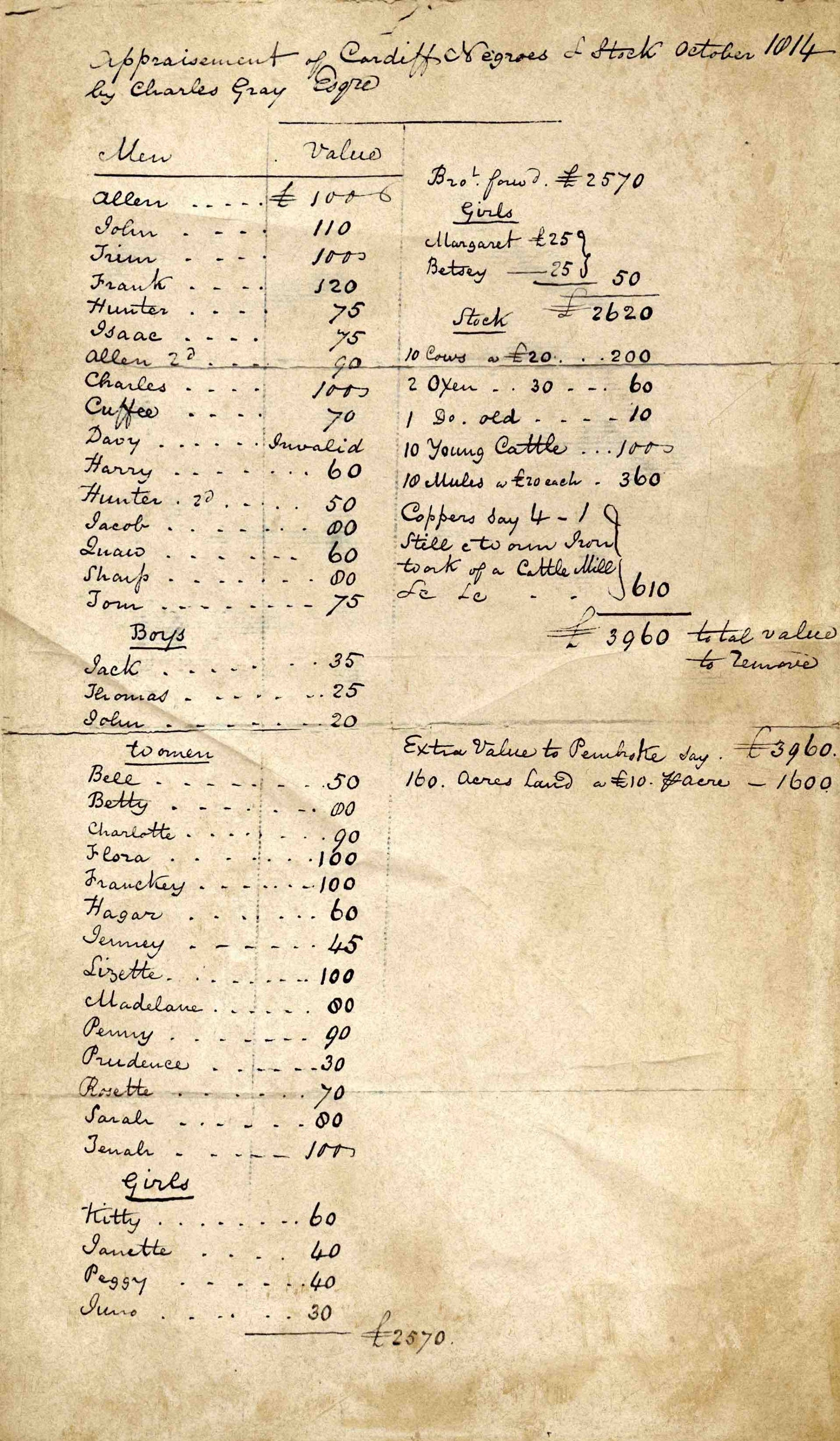
Appraisement of Cardiff Negroes & Stock October 1814 by Charles Gray Esq.
By Noor Hashmi
Charles Gordon Gray was the Vice President of the Bath and West of England Society between 1811 and 1821. During this time, he was also a plantation overseer for Cardiff Estate and wrote an appraisal in 1814. This was a financial and administrative document that assigned monetary value to enslaved people and other commodities and showed how much they were “worth” to potential purchasers, whilst also demonstrating the wealth derived from plantation ownership.
The appraisal lists enslaved people by name and groups them into four categories: “Men”, “Boys”, “Women”, and “Girls”, with a subtotal of £2,570. The most striking aspect of this appraisal is that enslaved people are grouped with livestock and cattle on the same page, which are valued at £3,960. This emphasises how enslaved people were also viewed as commodities central to plantation labour and production, while their own voices and humanity remained absent from a document that shows the profitability of the estate, which was reliant on enslaved labour. Marisa Fuentes corroborates this by stating that enslaved people often survive in ‘archival silences’ and that ‘the objectification of the enslaved allowed authorities to be bought and sold, used to produce profit and to retain and bequeath wealth.’[1] Instead, human labour, cattle, acreage, and equipment were translated into figures that demonstrated the profitability of plantation slavery within an interconnected Atlantic economy.
This is emphasised further through describing a man called Davy as “invalid” with no explanation of why he had been labelled this way, like health conditions, old age, or disabilities. The focus is on his diminished value and lack of profitability. It is likely that the system of slavery itself caused him to become “invalid”. That said, colonial plantation documents were written from a White plantation owner’s perspective who prioritised finance and commodification in appraisals. To plantation administrators, being “invalid” was a sufficient explanation because it signified the inability to work on the plantations, which in turn decreased their chances of being bought and sold, as they were not “worth” anything to the estate. Thus, the usefulness of the source is limited as we are unable to write a ‘bottom up’ history from an African perspective, as they do not have an active voice within the source. Nevertheless, by reading against the grain, we can gain insights into their experiences and how they were viewed within the British Empire as commodities rather than humans.
The commodification of enslaved people is also evident in the fact that Kitty, a girl, is valued at £60, whilst the boys (Jack, Thomas, and John) are valued at £35, £25, and £20, where age and gender influenced the valuation of enslaved labour. In particular, women were relied on to produce the next generation of enslaved workers, as emphasised by Jennifer Morgan who states that ‘slaveowners understood quite early the value of the reproductive lives of laboring women’ [2] This is particularly true for this appraisal which was written by Gray in 1814 after the abolition of the transatlantic slave trade in 1807 when plantation economies in the Caribbean depended on the existing enslaved population for continued labour over time. From an administrative perspective, the appraisal demonstrates how Gray assessed future labour potential alongside present value. In a period of uncertainty after abolition, he attempted to convert the uncertain future of his estate into monetary values and wealth.
However, there is a stark contrast between this appraisal portraying Gray’s active role as a plantation overseer and appraiser in the Caribbean, and the Bath and West journal records, which have no reference to this in Britain. This contrast is significant because Gray was the Vice President of the Royal Bath and West of England Society, ‘the oldest Agricultural Society in the country’, which has made a ‘remarkable contribution to the development of farming practices and other aspects of the rural economy in the eighteenth and nineteenth centuries’ and still exists to this day. [3]The appraisal reveals that the same practices of valuation and estate management associated with agricultural improvement in Britain could be applied within Caribbean plantation agriculture. The absence of Gray’s involvement in plantation slavery from the Bath and West records illuminates how institutional records could celebrate agricultural improvement while leaving its connections to plantation slavery largely unspoken, despite the clear links between these two worlds.
Overall, the short-term significance of the appraisal is that it established the value of Cardiff Estate for financial and legal purposes. Its longer-term significance lies in revealing how practices of valuation and agricultural management connected Britain and Jamaica through systems of plantation slavery. However, further historical research into Bath and Somerset’s connections to slavery needs to be conducted, as they have received far less attention than those of London, Liverpool, and Bristol, despite evidence that these legacies remain embedded within local institutions.
Bibliography
Primary sources:
Appraisement of Cardiff Negroes & Stock, October 1814, by Charles Gray Esq.
Secondary sources
Fuentes, Marisa J., Dispossessed Lives: Enslaved Women, Violence, and the Archive (University of Pennsylvania Press, 2016).
Morgan, Jennifer L., Laboring Women: Reproduction and Gender in New World Slavery (University of Pennsylvania Press, 2004).
Internet sources:
‘The Royal Bath & West Society, from 1777 to Today’, www.bathandwestsociety.com/about-us (2021).
[1] Marisa J. Fuentes, Dispossessed Lives: Enslaved Women, Violence, and the Archive (University of Pennsylvania Press, 2016), p.5.
[2] Jennifer L. Morgan, Laboring Women: Reproduction and Gender in New World Slavery (University of Pennsylvania Press, 2004), p.82.
[3] ‘The Royal Bath & West Society, from 1777 to Today’, www.bathandwestsociety.com/about-us (2021).