
Charles Gordon Gray: Bath & West Vice President and the Cardiff Estate
Tracing the overlap of agricultural leadership and enslavement in the early 1800s

This article is part of the ongoing research of the Trust for Records of Enslavement and Emancipation (TREE). TREE works to preserve, interpret, and share archival records of enslavement and emancipation, connecting them to the histories of families, estates, and institutions across Britain.
Between 1811 and 1821, Charles Gordon Gray served as a Vice President of the Bath and West of England Society. He appeared regularly in meeting minutes, attended general assemblies, and received premiums for livestock exhibits. At the Society’s Annual Meeting of 16 December 1823, the minutes recorded his death and elected replacements to fill the Vice President vacancies.
At the same time, Gray was active in Jamaica as an appraiser and attorney for estates built on the labour of enslaved people. Archival records confirm his dual position in both Somerset civic life and Caribbean plantation administration.
Vice President of the Bath & West
Gray is listed as Vice President in the Transactions of the Bath and West of England Society throughout the 1810s. Attendance lists show “C. G. Gray Esq., V.P.” at meetings in 1812. Premium lists also record awards for livestock entries, including breeding ewes.
At the Society’s Annual Meeting of 16 December 1823, the minutes state:
“The Vice Presidents were re-elected and Philip John Miles Esq. and Eleazar Pickwick Esq. unanimously chosen to supply the vacancies caused by the death of Charles Gordon Gray Esq. and John Webb Weston Esq.”
This confirms Gray’s death before December 1823 and fixes his period of service.
Cardiff Estate, St Ann, Jamaica
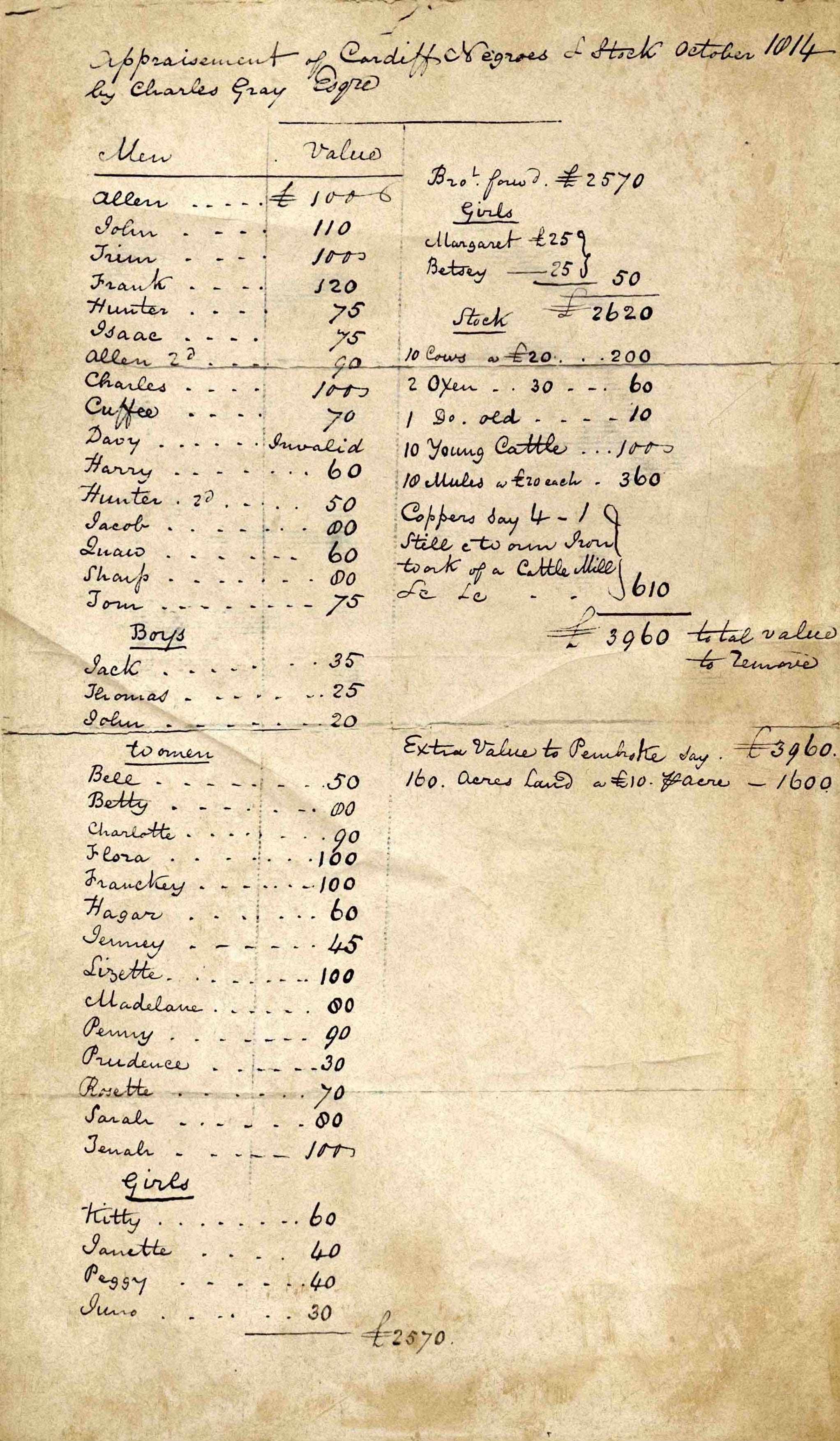
Among TREE’s archive is a one-page appraisal headed:
“Appraisement of Cardiff Negroes & Stock October 1814 by Charles Gray Esq.”
The document lists men, women and children by name, each with a monetary value. Examples include Allen (£100), Charlotte (£90), Harry (£60), Kitty (£60), and Juno (£30). A subtotal of £2,570 is entered for enslaved people, set alongside valuations of livestock, cattle and equipment.
This places Gray in the role of valuing human lives as property, two thirds of the assessed estate wealth, at the same time he held office in Somerset.
Estate Roles Recorded in Jamaica
The Legacies of British Slavery project confirms Gray’s wider involvement in estate management in St James, Jamaica. Entries record him acting as attorney for several estates:
Irwin Estate, St James: “In the possession of Charles Gordon Gray as Attorney to Thomas K. Hall” (1820–1821).
Kirkpatrick Hall Estate, St James: “In the possession of Charles Gordon Gray as Attorney” with 20 enslaved people purchased in 1819.
Stapleton Pen, St James: “In the possession of Charles Gordon Gray as Attorney” (1820–1821).
Industry Estate, St James: referenced in litigation, Gray v Hinde.
These records demonstrate Gray’s direct engagement in plantation administration during the same years that Bath & West listed him as Vice President.
Silence in the Bath & West Record
Across Bath & West journals and minutes between 1811 and 1822, Gray is presented only as a Vice President, exhibitor, and prize winner. No mention is made of his roles in Jamaican estates or his 1814 appraisal of enslaved people.
This silence illustrates how the Society recorded civic respectability while omitting the colonial origins of some of its members’ wealth and authority.
Why This Matters Today
The records show how Charles Gordon Gray’s two worlds intersected. In Jamaica, he was responsible for valuing enslaved people and managing estates. In Somerset, he was celebrated as a Vice President and exhibitor in one of Britain’s leading agricultural societies. The Bath & West journals recorded only one of those worlds.
For TREE, the relevance lies in how institutions today choose to address these histories. By bringing forward archival evidence, TREE is working with organisations to:
Acknowledge connections between civic prestige and slavery wealth.
Ensure transparency in how institutional histories are presented.
Develop education resources that place these stories in classrooms.
Support inclusive conversations in a sector that has been repeatedly described as one of the least diverse in the UK. Estimates suggest that people of colour make up only around 1% of the UK agricultural workforce, despite forming a much larger share of the population (Nuffield Farming Scholarships Trust, 2021). Initiatives such as AgDiversity continue to highlight low representation across ethnicity, disability, and sexual orientation (Nuffield Farming Scholarships Trust, 2022).
By surfacing hidden histories and recognising the global contributions and costs that shaped institutions like the Bath & West, TREE aims to help foster more inclusive conversations in a sector where they have too often been absent.
This research is not about diminishing the Bath & West’s role in agricultural history. It is about setting it in its full context and ensuring that the lives of those appraised at Cardiff in 1814 are not forgotten.
References
Bath & West Society
Transactions of the Bath and West of England Society, General Meetings (1811–1821); Annual Meeting, 16 Dec 1823 (minutes). (38/1/4)
Premium lists including awards to Charles Gordon Gray.(38/1/4 and 38/9/1)
TREE Archive
Appraisement of Cardiff Negroes & Stock, October 1814, by Charles Gray Esq.
UCL Legacies of British Slavery
Irwin Estate, St James (1820–1821).
Kirkpatrick Hall Estate, St James (1819–1821).
Stapleton Pen, St James (1820–1821).
Industry Estate litigation, Gray v Hinde.
Sector Diversity References
Nuffield Farming Scholarships Trust, Encouraging and Supporting Black and People of Colour in Agriculture(2021).
Nuffield Farming Scholarships Trust, AgDiversity Programme (2022).
About TREE
The Trust for Records of Enslavement and Emancipation (TREE) is dedicated to uncovering, preserving, and interpreting archival records of enslavement and emancipation. Our mission is to connect these histories to the present, ensuring they are accessible for education, heritage, and public understanding.
This article is part of TREE’s research series on slavery connections in Britain’s regional institutions.
Prepared by Matt Johnston, Founder & Trustee of the Trust for Records of Enslavement and Emancipation (TREE).
treefoundation.org.uk | info@treefoundation.org.uk | @t.r.e.e.foundation_uk