

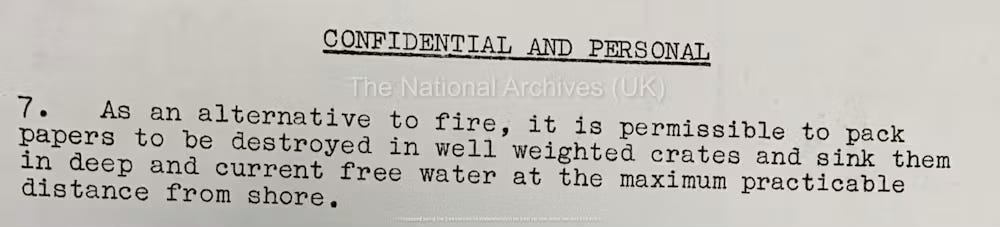
Operation Legacy was the British government’s programme of colonial record destruction during the late 1950s to 1970s. It was organised through the Colonial and Foreign Offices, endorsed at Cabinet level, and carried out by governors across the empire. The deliberate narrowing of archives left deep silences in the historical record. Against this backdrop, TREE’s collection of eighteenth- and nineteenth-century documents demonstrates the value of what survived and the importance of bringing suppressed histories back into the open.
What Operation Legacy Was
Between the late 1950s and the 1970s, as Britain prepared to grant independence to colonies across Africa, the Caribbean, and Asia, officials oversaw the destruction or removal of thousands of documents. Records that might expose human rights abuses, mistreatment of local populations, or policies deemed damaging to Britain’s international reputation were targeted.
This was not the action of individuals working in isolation. It was an organised programme run by the Colonial Office, later absorbed into the Foreign and Commonwealth Office (FCO). It was endorsed at ministerial level and implemented by governors, colonial secretaries, and senior civil servants in each territory.[1]
How the Programme Was Organised
Policy direction: The Colonial Office issued secret circulars with precise instructions on which records should be destroyed.[2]
Selection process: Documents were categorised. Material that might “embarrass Her Majesty’s Government,” or “be interpreted unfavourably by successor governments,” was earmarked for destruction.
Local implementation: Colonial governors convened committees to supervise the “weeding” of archives. They were required to produce certificates confirming destruction had taken place.[3]
Oversight: The FCO in London retained lists of categories and monitored compliance. Some files were secretly shipped back to Britain for storage at Hanslope Park, later revealed as the “migrated archives.”[4]
The process itself was bureaucratic. The destruction of evidence was logged, signed off, and certified, leaving behind what has been described as an “archive of erasure.” The very act of concealing colonial violence produced its own paper trail.
Where Accountability Sat
Operation Legacy was carried out in the name of the Crown, but responsibility lay firmly with the elected government of the day.
Government ministers: The Colonial Office, and later the FCO, directed the policy. This was endorsed at Cabinet level. Responsibility spanned successive administrations of both major parties, including Conservative governments under Harold Macmillan, Alec Douglas-Home, and Edward Heath, as well as Labour governments under Harold Wilson and James Callaghan.
Foreign Office oversight: Once the Colonial Office merged into the FCO, responsibility for safeguarding reputational interests transferred to senior officials there.
Governors: Each colonial governor was personally responsible for certifying compliance in their territory. Certificates were signed to confirm destruction.[5]
The monarchy: The programme did not require Royal Assent. As head of state, Elizabeth II was formally the sovereign in whose name the policy was enacted. In practice, constitutional convention meant she did not direct government policy. The Queen may have been generally aware that sensitive files were being withheld from successor governments, but she had no executive power to block ministerial decisions.
TREE’s position is clear: Operation Legacy was a ministerial policy, designed and carried out by government departments, implemented locally by governors, and justified as protecting the Crown.
The Consequences of Erasure
This destruction left deep gaps in the archives of former colonies. In many cases the new independent governments received only fragments of administrative history, carefully filtered by the departing power. For researchers today, this means the story of colonial rule is incomplete.
The silences are not neutral. They are evidence of deliberate erasure. To study these gaps is to see what Britain did not wish successor states to know, and what it did not wish history to record.[6]
Partial Disclosure and Limited Redress
The migrated archives: In 2011, during a High Court case brought by Mau Mau veterans, the government admitted that thousands of colonial-era files had been secretly held at Hanslope Park. Around 20,000 were subsequently transferred to The National Archives between 2012 and 2013. These cover 37 former colonies.[7]
Kenya compensation: In 2013, the UK government issued a statement of regret for torture during the Mau Mau Emergency and agreed a £19.9 million compensation package for over 5,000 victims. Then Foreign Secretary William Hague expressed “sincere regret” in Parliament.[8]
Beyond Kenya: No equivalent apology or reparations have been extended to other colonies. The disclosure of the migrated archives was a partial restoration of openness, but the majority of documents incinerated under Operation Legacy remain permanently lost.
TREE’s Archive in Contrast
Against this backdrop of systematic removal, the survival of certain records takes on heightened significance. The Trust for Records of Enslavement and Emancipation (TREE) holds a collection of documents that escaped both the passage of centuries and the selective destruction of more recent times.
Our living archive includes:
An estate inventory from Tobago (1773), listing enslaved people alongside property and livestock.
A compensation counter-claim from the 1830s, revealing the financial disputes that followed emancipation.
Caribbean newspapers such as the Grenada Gazette (1814) and the Tobago Chronicle (1842), which preserve accounts of law, commerce, and society in the period after emancipation.
Unlike the records selected for destruction under Operation Legacy, these documents were not filtered to protect reputations. They record in unvarnished terms the economic, social, and legal structures of their time.
Bringing silenced histories back into the open
By transcribing, annotating, and publishing these materials, TREE is restoring access to conversations that were once deliberately suppressed. Estate inventories show how human lives were catalogued and treated as property. Compensation records reveal the scale of financial interest tied to enslavement, and the extent to which those interests continued after abolition. Newspapers document how colonial societies policed, legislated, and justified their actions.
Each document added to the public domain helps fill the gaps left by deliberate erasure. They allow researchers, educators, and communities to interrogate history on their own terms, rather than through the narrow lens left by official censorship.
The benefit of preservation today
Bringing these records back into the open does more than safeguard the past. It:
Strengthens the base for education, research, and public history.
Restores visibility to those whose lives were reduced to numbers, assets, or disputes.
Provides successor generations with a fuller account of the structures that shaped their histories.
Counters the precedent of concealment by showing that archives can be shared openly rather than restricted.
In this sense, TREE’s work is not only about keeping rare documents safe, but about challenging the culture of forgetting that Operation Legacy embodied.
Why This Matters Now
Operation Legacy was intended to protect Britain’s reputation at the moment empire receded. Its effect has been to narrow the historical account. TREE’s work takes the opposite course: safeguarding, openness, and accessibility.
Each document transcribed, digitised, and placed in the public domain expands the record available for research and education, pushing back against enforced forgetting. The survival of collections such as TREE’s is critical. They offer insight into systems of ownership, finance, and power that shaped lives and continue to shape legacies.
Where the state once sought to erase, institutions like TREE work to protect and share. This ensures that silenced histories return to view, and that the historical account endures.
References
Caroline Elkins, Legacy of Violence: A History of the British Empire (London: Bodley Head, 2022).
David M. Anderson, Histories of the Hanged: The Dirty War in Kenya and the End of Empire (London: Weidenfeld & Nicolson, 2005).
The Guardian, “Britain destroyed records of colonial crimes,” 18 April 2012.
The National Archives (UK), “Colonial administration records (migrated archives),” 2012 guidance.
Hanslope Park disclosures, Foreign and Commonwealth Office, 2011.
Elkins, Legacy of Violence; Anderson, Histories of the Hanged.
The National Archives, “Migrated archives overview,” 2013.
UK Parliament, Hansard, Foreign Secretary William Hague statement on Mau Mau compensation, 6 June 2013.
About TREE
The Trust for Records of Enslavement and Emancipation (TREE) is dedicated to uncovering, preserving, and interpreting archival records of enslavement and emancipation. Our mission is to connect these histories to the present, ensuring they are accessible for education, heritage, and public understanding.
This research note was prepared by Matt Johnston, Founder & Trustee of the Trust for Records of Enslavement and Emancipation (TREE).
treefoundation.org.uk | info@treefoundation.org.uk | Follow us: @t.r.e.e.foundation_uk