

Since the last newsletter update in January 2026, TREE’s work has continued to grow across schools, heritage settings, and wider institutional spaces. This update reflects what has taken place since that point.
⸻
Working Within Historic Spaces
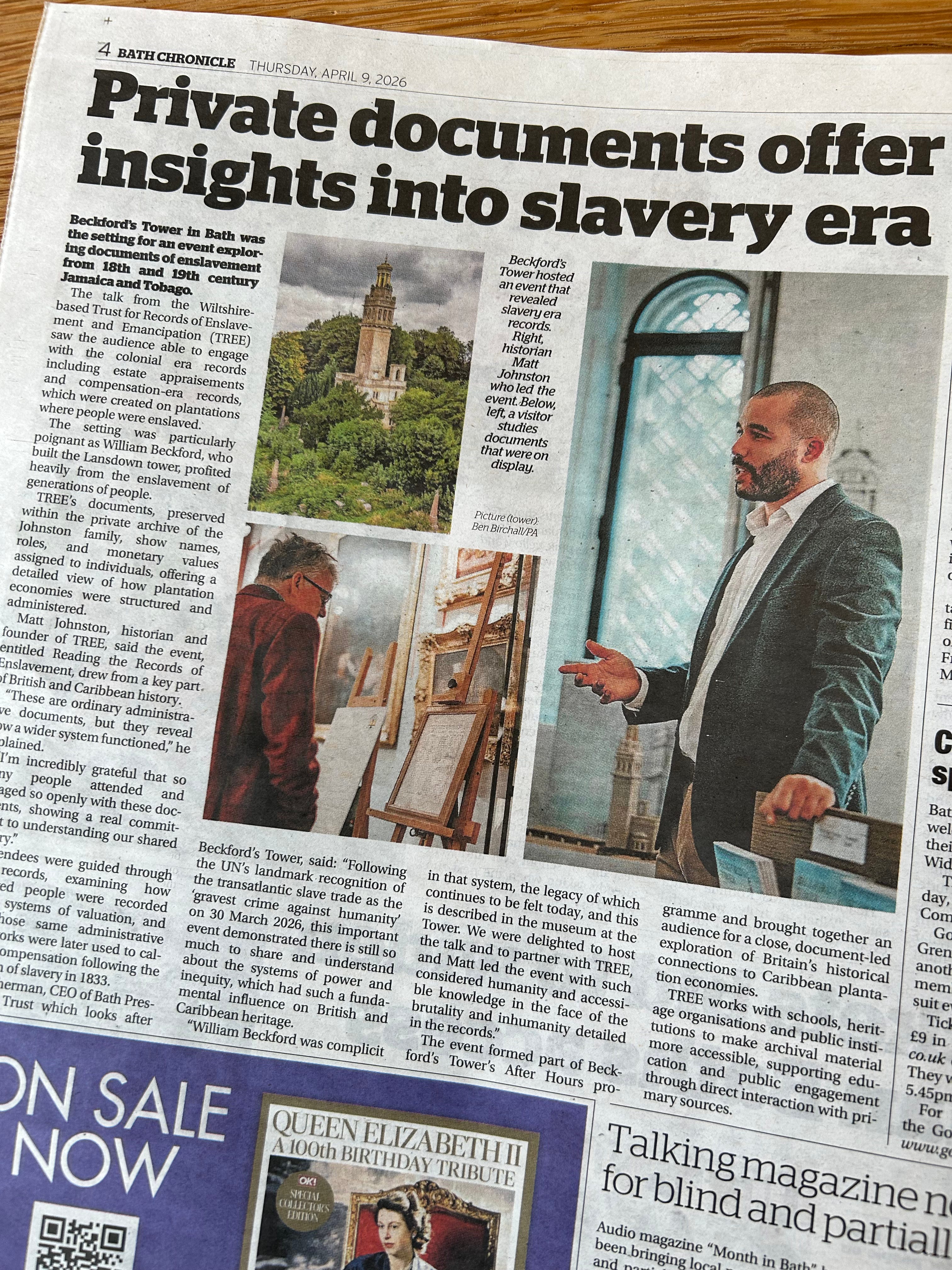
TREE recently welcomed the public to an evening at Beckford’s Tower in partnership with Bath Preservation Trust.
The event, Reading the Records of Enslavement, focused on bringing original documents into the space and enabling direct engagement with our collection of artefacts.
Beckford’s Tower is directly tied to wealth generated through colonial and enslavement-era systems, so holding a talk there required a clear and thoughtful approach. The focus stayed on primary sources - administrative records that were never intended to tell stories, but reveal how those systems functioned.
The event reached full capacity in advance and led to further engagement from educators and institutions looking at how this work can be delivered within their own settings.


Education and Public Engagement
TREE has delivered a series of sessions at Kingswood School spanning across primary and secondary year groups.
These sessions use original documents, supported by contextual material, to explore how historical systems recorded and categorised people.
This has included:
• A Windrush-focused assembly drawing on family history and artefacts
• Sixth Form discussions examining political and administrative structures
• Year 10 and 11 sessions addressing language, literature, and historical context
TREE has also continued delivering ‘Hands-on History’ workshops for younger learners outside of school settings, giving the opportunity to work directly with artefacts and archival material in an approach that lead by the learner.
Across each setting, the approach is consistent. Primary sources come first. Interpretation is there to support understanding, without replacing direct engagement with the records themselves.


Evidence in Circulation
TREE’s work with national institutions is also ongoing, with an evidence pack submitted to the National Trust to support the development of its Colonialism and Historic Slavery interpretation remaining under review. This is a process that reflects the need for care and accuracy in evidence-based work.
More broadly, TREE is increasingly being approached to support organisations in how complex histories are evidenced and presented. This work includes contributing to conversations across both the heritage and education sectors, helping to shape how historical material is researched, understood, and shared.
⸻
Press and Public Record
Recent coverage of TREE’s work has grown, appearing across a number of publications, including:
• Wiltshire Gazette and Herald
• Soldier Magazine -(pg 29)
With coverage across regional and national publications, the public record of TREE’s work grows.
Words Matter
Looking ahead, TREE’s Words Matter work will move into a more public phase during 2026. This focuses on how language is used across institutional, educational, and public contexts when discussing enslavement and colonial history.
It is grounded in archival accuracy, UK guidance, and professional practice, with the aim of helping organisations use language that is precise, historically accurate, and appropriate to the material.
⸻
A growing body of work
Since January, engagement with TREE materials has continued across schools, home education, and heritage settings. Primary sources, including estate inventories, correspondence and newspaper records, are being read and examined in detail.
This reflects the core approach of the TREE Foundation, placing the material into circulation so it can be explored and understood more directly.


Reflection
by Sunday Johnston
Working with these documents means spending time with records that were originally created to organise and account for people. You can begin to understand not just what was recorded, but how and why it was recorded in that way.
When they are presented in schools or public settings, the focus is on reading what is there whilst recognising what is missing.
Being a part of TREE means helping to bring these records into spaces where they can be understood directly, rather than explained from a distance.
That responsibility spans across generations. These documents have been held within our family, and are now being shared more widely, enabling others to engage with the documents for themselves
⸻
TREE exists to preserve these records and to ensure they are handled with accuracy, clarity, and care.
Instagram: @t.r.e.e.foundation_uk