

Over the past academic year, the TREE Foundation has worked with Kingswood School on a series of educational activities focused on archival records connected to enslavement, emancipation, migration, and historical language.
The sessions were delivered across History & Politics, English, and assembly settings, allowing different forms of engagement depending on age group and context.
TREE used material drawn from a family-held archive of original eighteenth and nineteenth-century records connected to enslavement and emancipation.
Founded in 1748 by John Wesley, Kingswood School has longstanding historical links to abolitionist movements through Wesley’s opposition to the transatlantic slave trade. His publication Thoughts Upon Slavery (1774) became one of the most widely circulated anti-slavery texts of the eighteenth century and contributed to wider abolitionist debate in Britain.
The sessions delivered by TREE focused on direct engagement with historical records and the interpretation of primary source material within educational settings.
“Students encountered original records within their historical context rather than through summary alone.”
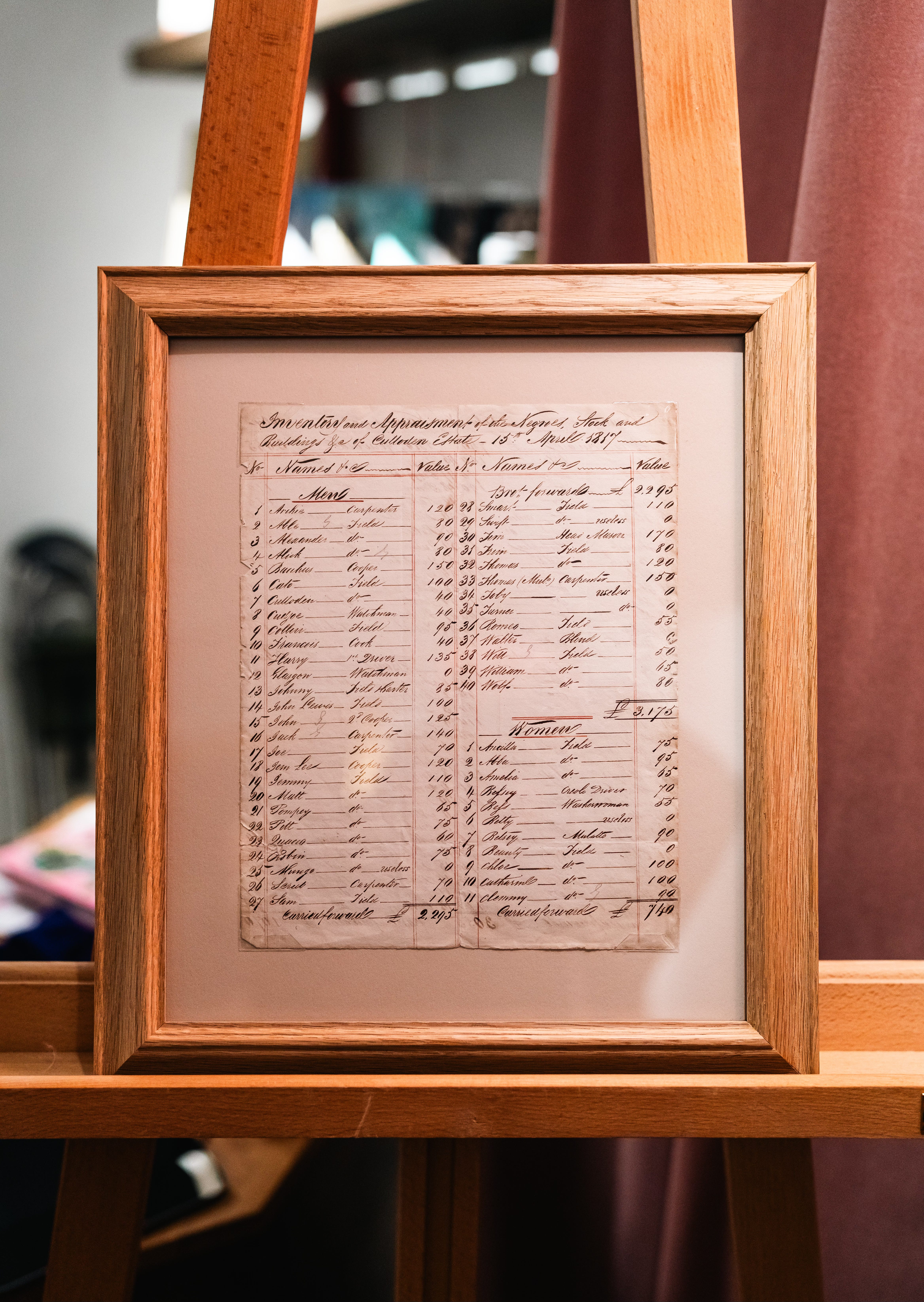
Sixth Form History & Politics
TREE delivered talks for the Sixth Form History & Politics Society using original archival material connected to enslavement and emancipation.
Students examined:
estate inventories
valuations and appraisements
plantation correspondence
nineteenth-century Caribbean newspapers
compensation-era documentation
Discussion focused on how records were created, the administrative language used within them, and how historians interpret archival evidence.
Original documents were displayed using framed conservation-standard presentation materials alongside contextual interpretation boards.
Students were encouraged to examine:
authorship
purpose
terminology
omissions within the records
relationships between administration, commerce, and human valuation
The talks also explored how archival material connected to the Caribbean intersects with British institutional, economic, and social history.
Year 10 and Year 11 Sessions on Historical Language


Separate sessions were delivered for Year 10 and Year 11 students examining historically offensive and racially charged terminology within literary and archival contexts, including discussion around use of the N-word within education and literature.
The sessions focused on:
contextual interpretation
historical terminology
distinctions between quotation, analysis, and usage
the relationship between language and systems of classification
how language changes across time and culture
Examples from literature and archival material were used throughout the sessions.
Students also examined how terminology connected to ethnicity and identity has shifted over time and how educational settings approach those changes today.
Year 6 Windrush Assembly


TREE also delivered a Year 6 assembly focused on migration, family history, and the Windrush generation.
The assembly incorporated:
family artefacts connected to Jamaica and migration
oral history recordings
personal and family narratives
discussion around identity, movement, and settlement in Britain
Objects including a family trunk and watch connected to the Windrush generation were used during the session, alongside recorded reflections discussing migration to the United Kingdom and experiences of adjustment and education.
The assembly introduced students to the idea that historical interpretation can emerge through both archival records and family-held material culture.
Original Records in the Classroom
Across all sessions, the educational approach centred on direct engagement with primary source material.
Students encountered handwritten records, printed newspapers, valuations, and archival language within their original historical context rather than through summary alone.
The material demonstrated how systems connected to enslavement and emancipation were recorded administratively through inventories, correspondence, financial records, and newspaper reporting.
The use of original artefacts also introduced students to practical questions around:
preservation
provenance
interpretation
archival handling
evidential analysis
Continuing Educational Work
The work between TREE and Kingswood School forms part of a wider programme of educational engagement focused on archival interpretation, historical language, and primary source analysis.
TREE’s educational approach centres on direct engagement with archival evidence, contextual interpretation, and structured discussion.
Further educational partnerships and collaborative programmes are currently in development.
TREE is currently developing further partnerships with schools, colleges, universities, and heritage organisations interested in evidence-led educational work using original archival material.
This includes:
student talks and workshops
teacher CPD sessions
archival interpretation sessions
support around historical terminology, contextual interpretation, and archival engagement
collaborative exhibition and education projects
Organisations interested in working with TREE can get in touch via support@treefoundation.org.uk
Support TREE’s educational and archival work: